| |||||||||||||||||||||||||||||||||||
| |||||||||||||||||||||||||||||||||||
| |||||||||||||||||||||||||||||||||||
| |||||||||||||||||||||||||||||||||||
 | |||||||||||||||||||||||||||||||||||
Games venture funding fell roughly 80% from its 2021 peak to 2025, and it isn’t coming back the way it was. Venture wants the one hit. Private capital, roughly nine times bigger, wants operating businesses with margins, catalogs and a real way to reach players. Games isn’t broken, the way we fund and sell it is. Studios need to stop pitching the wrong pool of capital. | |||||||||||||||||||||||||||||||||||
By Neil Haldar · 12 min read · Sources linked inline | |||||||||||||||||||||||||||||||||||
 | |||||||||||||||||||||||||||||||||||
The 2021 party is over. Nobody turned the lights back on. | |||||||||||||||||||||||||||||||||||
Let’s start with the number everyone in this industry already feels in their gut. Private investment in games was about $12.6 billion in 2021. In 2025 it was $2.6 billion, a drop of roughly 80%, spread across 450 deals. [Aream & Co] 2026 looks better on paper (Q3 alone brought in $2.8 billion, more than triple a year earlier), but $1.2 billion of that went to three AI companies. [Aream & Co] Meanwhile, seed money in games just hit a five-year low. [GameDev Reports] | |||||||||||||||||||||||||||||||||||
And this is happening while games themselves are fine. Gaming stocks jumped about 15% in Q3 2026, and GTA VI lands on November 19. [Drake Star] [Rockstar] Players spent $201.6 billion on games in 2025, up 9.1% and the first year the market cleared $200 billion. Mobile alone brought in $113.3 billion, up 10.7%, more than PC and console combined. [Newzoo] | |||||||||||||||||||||||||||||||||||
Console prices keep climbing, and US hardware is feeling it: Switch 2 now costs $499.99 and a PS5 starts at $599.99, and Circana has US hardware spending down 11% this year through August. [Nintendo] [PlayStation] [Circana via GamesBeat] Yet Switch 2 still shipped 23.68 million units in its first 13 months, Nintendo’s fastest start ever. [Nintendo] [VGC] Worldwide, consumers are still spending at record levels. It’s us that is broken. This is not a repeat of 1984, the North American crash, when players walked away. | |||||||||||||||||||||||||||||||||||
Public markets are buying. Venture just stopped writing checks to people who make games. So where did the money go? | |||||||||||||||||||||||||||||||||||
 | |||||||||||||||||||||||||||||||||||
It didn't leave games. It changed shape. | |||||||||||||||||||||||||||||||||||
| |||||||||||||||||||||||||||||||||||
Read that list again. Every category on it is funding something that already works: a tool with traction, a franchise with cash flow, a hit with retention, a UA loop with proven payback. Almost none of it funds an idea on a napkin. | |||||||||||||||||||||||||||||||||||
| |||||||||||||||||||||||||||||||||||
 | |||||||||||||||||||||||||||||||||||
This is what a capital drought looks like from the inside | |||||||||||||||||||||||||||||||||||
Follow the scarcity, and you find who pays. Every economic system needs something in it to be scarce, or else it becomes a lowest-price free-for-all. It used to be that being a developer was pretty scarce; the technical and artistic prowess required to deliver a melded experience that brought players to distant worlds was a feat unto itself. With today’s near paint-by-numbers game engines and editors, and the looming asset workhorse of AI, the floodgates are open. The stores also don’t offer scarcity; they take all comers and don’t curate the dead, dying, or bankrupt. An infinitely sized store will forever keep selling everything that anyone ever tried to sell. Therefore, the scarcity is in the audience. We have plenty of games but not enough right-sized pools of consumers buying all of them. And so the impact falls disproportionately on the talent, the people of the industry. | |||||||||||||||||||||||||||||||||||
Tracking by Amir Satvat and the independent Discord group Game Industry Coffee Chat [gameindustry.cc] counted about 15,600 games layoffs in 2024 and about 9,000 in 2025. [GamesBeat] 2026 is worse again: 10,512 confirmed through September 28, with a projected total near 13,800. [ASGC tracker] | |||||||||||||||||||||||||||||||||||
The closures read like a roll call. Ubisoft shut Winnipeg and Belgrade. Embracer closed Vertigo Games’ Amsterdam studio. Queen Digital, the startup from two former King execs, closed. Bungie cut around 300. [Layoff tracker] Drake Star’s own interview noted major layoffs or shutdowns virtually every week of Q3. [GamesBeat] And just yesterday, Electronic Arts announced the end of BioWare, part of about 400 layoffs, with possibly more to come. [Variety] | |||||||||||||||||||||||||||||||||||
A lot of those studios built great products. But they were built and funded in a world where the next round always showed up. When it didn’t, there was no bridge, because nobody had built a business that a non-venture investor could underwrite. | |||||||||||||||||||||||||||||||||||
To win, we have to stop thinking about every game being a hit and instead build a strong portfolio of offerings that could also contain a hit. Venture really only wants the big hits, but if we want a sustainable industry, we have to stop making layoffs a part of every cycle of hit-driven innovation. The practice of games needs the bulwark of cash flow from catalog sales to stabilize the up-front guesses of tomorrow’s hits. That’s not a one-hit-wonder studio, that is a publisher with a portfolio. | |||||||||||||||||||||||||||||||||||
 | |||||||||||||||||||||||||||||||||||
Stop pitching the wrong pool of money | |||||||||||||||||||||||||||||||||||
Here’s my take, and I’ll say it plainly. Games is maturing and is largely no longer a ’Venture Class’ sector. That isn’t an insult. It’s what happens to every industry that grows up. | |||||||||||||||||||||||||||||||||||
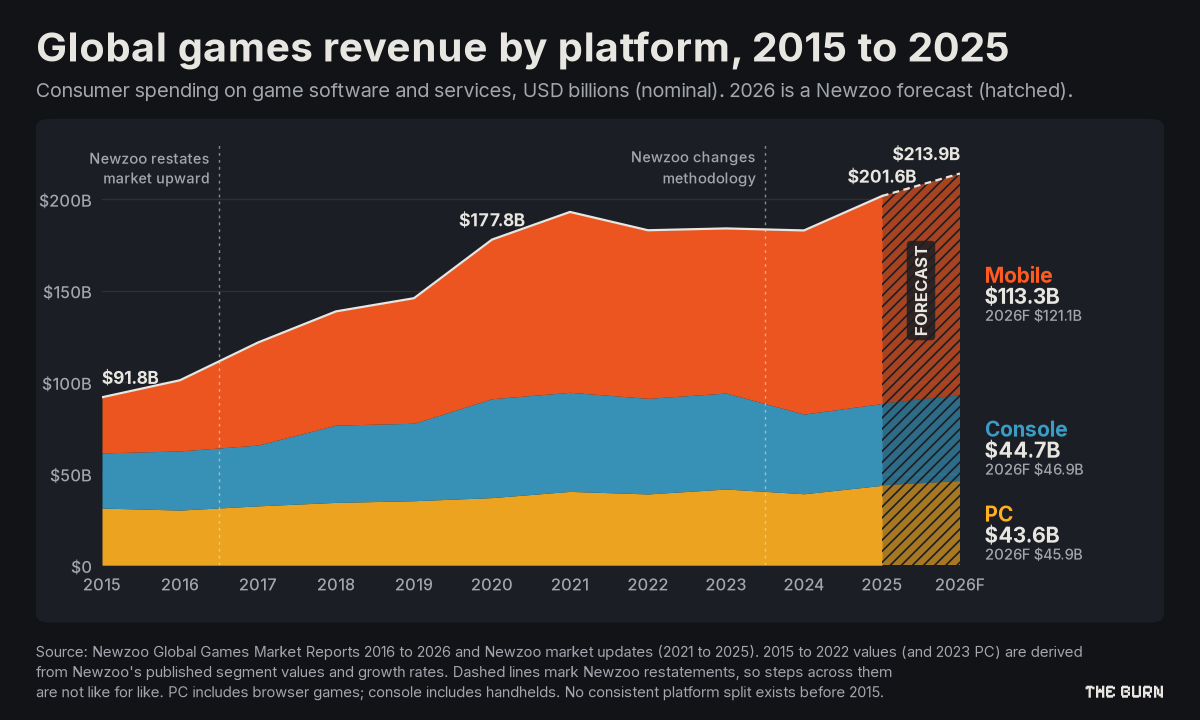 Note: about three-quarters of the growth over the last 10 years came from mobile. Newzoo | |||||||||||||||||||||||||||||||||||
Venture class companies solve problems with a simple premise, an innovative hat trick as the solution, and the entire world as their potential customer. The ‘hat trick’ is something no one else could do or should’ve done, but they did it anyway, and successful VC-backed companies figure out how to bring in customers by the truckloads. Where VCs excel is in sprinkling small bits of investment cash across lots of potential ideas, like many seeds in the garden. In the real world, many of those seeds won’t make it. This is why venture needs a shot at 100x return, where they take 100 shots on goal and 80 of the companies don’t make it, and the biggest 5 that do go all the way to the moon. It’s just how the ratios of ideas-to-leaders are. | |||||||||||||||||||||||||||||||||||
There was a time where we had similar dynamics in games; the low cost of making the game versus the potential market size of customers had similar stats. But as hardware generations marched forward, the cost of making games slowly exploded, in terms of complexity of content and number of man hours needed to wrangle difficult assemblies across levels and narratives into place. As former PlayStation studios chief Shawn Layden told Eurogamer in 2024, “Every generation it costs twice as much to build a game. It goes exponentially.” [Eurogamer] Today’s game market doesn’t look like how it was in the ’90s or ’00s; real AAA games are now expensive, unwieldy projects with complex construction paths that need lots of smart people to put them together. | |||||||||||||||||||||||||||||||||||
Unfortunately, games have barely grown since 2021. While costs have gone up, unit sales and total revenues have not kept pace. What was once a great venture bet has now turned into an exercise of just paying back the costs. As an industry, we haven’t collapsed, we’ve simply matured. Most of the game industry now works this way, we just don’t realize it yet. These days, studios are taking old-style investments and burning through people and cash, trying to find success, only to end up bankrupt with asset sales. This kind of systemic crashing doesn’t attract investors. It attracts bankruptcy lawyers. And game studios can no longer act as if their investor is just a disinterested, passive altruist with a giant credit card. Fundamental business efforts to build stable and capable studios and publishers must become the norm, rather than hoping the business will simply “work itself out” if you build “something great.” | |||||||||||||||||||||||||||||||||||
The game companies that will succeed at obtaining funding will work like real operating businesses. Damodaran’s January 2026 data puts the pre-tax operating margin of 77 US entertainment software companies at about 34%. [NYU Stern (Damodaran)] EA reported a 20.4% GAAP operating margin for fiscal 2025 (31.2% on its adjusted basis). [EA] Those are the scaled, public winners, and most independent studios earn less, but the shape is clear. A focused studio that ships good games and makes a steady 20-30% margin on its money is a great private capital investment but yields a poor venture return. | |||||||||||||||||||||||||||||||||||
Last year over 20,000 games came to Steam. [SteamDB] As last week’s THE BURN noted, the rise of AI construction tools will let super-small, entirely unproven, and unfunded studios bring their games to market for a fraction of the cost. This sudden drop in production costs will yield a tremendous flood of AI games reaching all stores: console, mobile app stores, and all PC stores, especially Steam. Already, we have begun recording a lot of VC bets in the direction of AI, which brings back the old venture win-loss ratios. [Drake Star] As that AI velocity picks up, VC investors may have a hard time picking winners and losers out of that growing, unending torrent. Private capital will fare no better; to expect unseasoned capital sources to have the nose and capability to choose winners as well as, or better than a qualified, established publisher is a pretty rough bet. | |||||||||||||||||||||||||||||||||||
More likely: in a flooding market, publishers and labels will make a comeback. Capital will be interested in operating publishers with a cashflow-positive portfolio who can better pick and support winning games and have diversity across a litter of games. Those publishers and labels are not only the names we know today but also future entities that know how to collectively scout for new games, manage a portfolio, market new offerings, and have the cash flow to pay investors. | |||||||||||||||||||||||||||||||||||
It would be very grinding and an inefficient use of investor money for every developer to choose self-publishing and be exposed to the high marketing costs of the bid-based UA world, needing not only great marketing talent but also the time it takes to build up UA channel efficiency, ongoing UA buying hypotheses and UA creative capacity. In such a world, many developers may want to simply focus on the craft of making a great game and leave the additional nuanced insanity of “marketing and publishing” operations to a specialist more suited to match audiences to offerings. ‘Hope’ is not a strategy, and “if they build it, they will come” is a non-starter that needs to be urgently removed from studio executive planning in our industry. | |||||||||||||||||||||||||||||||||||
I cannot imagine a world where 60,000 to 80,000 new games a year on Steam all have their own connected islands of fandom, spanning TikTok, Reddit, Discord, extended socials, websites, and more. Can you imagine a thousand new Discords a week at this pace, each one vying for community and attention and promising early beta access and also merch? Neither can I. We will force the consumer to drown in our own noise. The magnifying effect of publishers and labels as entrusted concentrators of consumer attention and spend is inevitable. Their return is certain. | |||||||||||||||||||||||||||||||||||
So who funds their comeback? | |||||||||||||||||||||||||||||||||||
Look at where the capital actually sits. Excluding hedge funds, US private funds hold an enormous $19.8 trillion in gross assets, including private equity, roughly a third the size of all US stock markets combined. [Siblis Research] By contrast, US venture capital funds hold a much smaller $2.1 trillion, managed by roughly 3,300 venture capital advisers, [SEC Form ADV] and about half of that money sits in California. [NVCA] The industry has spent decades lining up at the smaller window. We have to let go of this muscle memory. | |||||||||||||||||||||||||||||||||||
Private capital funds operating businesses, not ideas on a napkin. It wants revenue, margins, a team that hits dates, and a plan for how the money comes back. Debt funds want cash flow. PE wants EBITDA. Strategics want IP and audiences. None of these capital sources want your single-product vision deck with an audience that is ‘for certain, trust me.’ Private capital wants your operating margin proof in your balance sheet, statement of cash flows, and income statement; the last 3 years of tax returns; and criminal background checks on anyone with access to the bank account. | |||||||||||||||||||||||||||||||||||
Who still raises? The winners that will emerge look like businesses that already operate and understand portfolio dynamics. They already found the hook, the rhythm, the thing that consumers can’t live without, for a while, or across franchises. Successful fundings won’t easily go to first-time or single-game studios, and not to a studio that says “no one has built a game like this before” or “my demographic is across all genders, ages 5-95!”. Real businesses dial into their audiences and understand how to deliver an entertaining product on time and at the right price. The funding winners know who they want to make the game for before they ask anyone to write them a check. | |||||||||||||||||||||||||||||||||||
The rounds still getting done prove the point: they are VC and strategics funding operating businesses, and private capital is about to give them competition. Circle Games, an Istanbul studio founded by veterans of Gram Games, Good Job Games and Dream Games, raised a $25 million Series A in September led by Tencent, with BITKRAFT and a16z speedrun. [PocketGamer.biz] Investors didn’t fund a pitch deck; they funded a live puzzle game already at an eight-figure annual run rate, two more titles behind it, and a team of 28 that only scaled marketing once paybacks were proven. [BITKRAFT] | |||||||||||||||||||||||||||||||||||
So here’s the whole meal. Count the courses with me. | |||||||||||||||||||||||||||||||||||
| |||||||||||||||||||||||||||||||||||
And that’s why we feel so broken. We so badly want to support the original ideas that we forgot the structure matters as much as the content. | |||||||||||||||||||||||||||||||||||
If you run a studio, build something private capital can underwrite: revenue, unit economics, clean books, and a team that ships. Rather than waiting for 2021 to come back, go find the bigger window. | |||||||||||||||||||||||||||||||||||
| |||||||||||||||||||||||||||||||||||
That’s the burn. Think I’m wrong? Good. Hit reply and tell me why. The best pushback may make the next issue. | |||||||||||||||||||||||||||||||||||
Neil Haldar Managing Director, HALDAR & CO · Las Vegas | |||||||||||||||||||||||||||||||||||
| |||||||||||||||||||||||||||||||||||
| |||||||||||||||||||||||||||||||||||
|
Opinion, not advice. THE BURN is personal commentary by Neil Haldar. It is not investment, legal, tax or accounting advice, or a recommendation to buy or sell anything. Do your own homework and talk to your own advisors.
© 2026 HALDAR & CO. You get THE BURN because you subscribe to The Burndown. HALDAR & CO, Las Vegas, NV Subscribe · Privacy |