|
|
|
| PLAYER 1: HALDAR & CO |
STAGE 1-1 · BIWEEKLY |
|
|
| One thing. Torn apart. |
from the makers of The Burndown |
|
 |
|
AI is already doing real work inside game studios, well past code and art, and licensed games can’t keep up. Steam is turning into YouTube. The brand playbook is out of road. And the one thing an algorithm can’t fake is about to get valuable again. |
By Neil Haldar · 12 min read · Sources linked inline |
LEVEL 01 · THE AI WORKFORCE |
Already on the payroll. Just not on the org chart. |
Stop calling AI in games a someday problem. It’s a right-now problem, and a lot of this industry is pretending otherwise because the honest answer is uncomfortable. The AI workers are already on the job. They just don’t show up in headcount. Here’s what has shipped or gone on the record: |
| > |
NPCs that think. Krafton’s inZOI launched Early Access in March 2025 with “Smart Zoi”: NPCs driven by an on-device NVIDIA ACE small language model. [NVIDIA] | | > |
NPCs that talk back. Epic put a conversational Darth Vader into Fortnite in May 2025, built on Google Gemini 2.0 Flash and ElevenLabs voice, with the James Earl Jones estate on board. [Epic] NetEase’s Where Winds Meet launched globally on November 14, 2025, with AI chatbot NPCs that hold freeform conversations with players. [PCGamesN] [Steam] | | > |
Teammates. Krafton’s PUBG Ally, an AI squadmate built on NVIDIA ACE, got a two-week public beta in June 2026, and Krafton’s own survey found players saw it more as a chatty companion than a real teammate. [Krafton] [Inven] Ubisoft’s Teammates is still a closed-test R&D experiment. [Ubisoft] | | > |
Quality Assurance AI. Square Enix has put it in writing: it wants generative AI handling 70% of QA and debugging by the end of 2027. [VGC] Razer sells an AI bug-hunter, QA Companion-AI, on AWS Marketplace. [Razer] | | > |
Art and voice. Black Ops 6’s Steam page says: “Our team uses generative AI tools to help develop some in game assets.” [Polygon] Embark uses text-to-speech built from contracted actors for callouts in The Finals and ARC Raiders. [PCGamesN] EA signed with Stability AI for texture and 3D pre-vis tools. [EA] | | > |
The org chart. Krafton declared itself “AI-first” in October 2025, organized around agentic AI. [VGC] At King, multiple anonymous staff told Mobilegamer.biz that some laid-off level designers and writers were effectively being replaced by the AI tools they had helped build, a claim King has not publicly addressed. [Mobilegamer.biz] | | > |
AI agents in live ops. Supercell uses GPT-4o-powered in-game agents for player support across Brawl Stars, Clash of Clans and other titles, handling most of up to 40,000 daily tickets on their own and passing risky cases to humans, according to developer Tomoro. [Tomoro] |
|
That’s the stuff that makes the trades. The bigger shift is in the parts of a studio nobody writes a press release about. Code and art get the headlines. Project management is where the hours go first: sprint notes, status reports, chasing dependencies across six teams, the weekly deck a producer burns a whole day building that nobody reads past slide three. AI is already eating that work, and good riddance. |
The notetaker knows. You’ve already had AI infiltrating your workflow: your AI notetaker. Plenty of teams have one sitting in every meeting, and most never touch the transcripts. The winners do. They run sentiment analysis across six months of standups, retros and milestone reviews, and the patterns jump out: the handoff that breaks every single sprint, the decision that keeps getting relitigated, the team that goes quiet whenever a certain topic comes up. |
It surfaces what’s working too, and that matters just as much. A leadership team’s memory of the last six months is a story it tells itself. The transcripts aren’t. The studios getting this right use them to fix the persistent wrongs and double down on the persistent rights. They do it in the open, aimed at fixing systems, not building a file on people. The ones that don’t have bought a surveillance tool, and they earn the attrition that comes with it. |
The jailbroken PS5 issue. Maybe a few tens of thousands will follow the route for as long as the jailbreak keeps working, until Sony patches it. But the damage is deeper: statements about “the complexity of backwards compatibility” by hardware makers are proven empty by AI-empowered modders, and social media turns their hobby-smithing into broadcast events. Users are finding ways to work together and have AI perform the tedious work of emulation construction and de-comp / re-comp by simply burning tokens. Expect a vociferous and hell-bent modder community to fence-test every release and every patch and have AI find the exploits faster than the Quality Assurance AI can find them from within the maker’s labs. |
The licensing trap. Here’s what nobody says on panels: the speed-ups AI allows are almost universally off-limits to anyone making a licensed game. IP holders and licensors don’t permit them. So the licensed team keeps hand-building assets, hand-recording lines and waiting on approvals while the original-IP studio down the street generates, tests, cuts and ships again. |
Then, yesterday, the wall cracked. Bloomberg reported that Epic has delayed its Disney shooter, the one with Marvel and Star Wars characters slated for March, and told the team to go “AI first”: “No more hand-written code,” with all art “generated with full AI workflows.” [GI.biz] Look at who gets to do it. Disney put $1.5 billion into Epic in 2024 and owns a piece of the company. When the licensor is also the investor, the rules bend. Every other licensed team still plays by the old ones, and now they’re racing a licensed game that doesn’t. |
The Vader experiment worked. Last year Epic, Disney and the James Earl Jones estate put a talking Darth Vader in Fortnite. Now that test has graduated into a whole licensed game going “AI first.” That’s a deal struck at the very top, not something a licensee’s dev team gets to decide on a Tuesday. Meanwhile, every other Hollywood studio and licensor is suing AI companies, not loosening terms for licensees and certainly not entertaining AI production tools at scale. [AP] |
That puts licensed games at real and growing risk. Licensees already pay the royalties and the approval tax. Soon they will pay a shadow AI tax on top, competing against unencumbered original IP that can move at whatever speed the tools allow. The gap widens every time the tools get better. If you’re underwriting a licensed game, price that in. If you own your IP, this is a structural advantage. Use it. |
It’s truly unfortunate, too, because the thing brands and IP bring in an AI-crushed storefront is discoverability. Without some leeway to use AI in production, licensed product will only get made as AAA experiences that rely on hand-curated everything. At that rate, the AI-coworked, homebuilt brands will win by sheer velocity of updates and become valuable IP islands of their own. |
That’s the boogeyman. Not a robot that makes the whole game, but a thousand small jobs that quietly stop being jobs: QA passes, growing amounts of voiceover, art textures, status reports, meeting follow-ups, first-pass tuning, workflow updates, standup summaries, finance check-ins for work and velocity, and making marketing assets at scale. The studios that redesign around this will ship more with fewer people. The ones pretending it isn’t happening will be stuck with legacy tools and processes, needlessly overspending against teams half their size, and they won’t see it coming, because none of it shows up in anyone’s headcount. |
LEVEL 02 · STEAM IS YOUTUBE |
The algorithm picks the winners |
My take: the future of Steam is YouTube. Forget the format. I mean the physics. Trackers counted roughly 20,000 new releases on Steam in 2025. [How To Market A Game] At that volume, nobody browses. The algorithm browses for you. |
Valve has been building toward this for years. Its machine-learning Interactive Recommender, trained on what people actually play, became a permanent store feature in 2020. [KitGuru] Discovery queues, “more like this” and wishlists all feed the same loop. A game lives or dies on whether its early engagement teaches the machine to keep showing it. |
So Steam is a creator platform now, whether you like it or not. Your launch is an upload. Your capsule art is a thumbnail. Your first weeks of engagement are your watch time. Build your studio like a great channel: ship often, be readable at a glance, iterate in public, and obsess over the signals the algorithm actually reads. And don’t go quiet. |
Imagine a world where the AI-generated product is a tidal wave. 50k to 75k new games a year, all fighting for attention. All good attempts, but few getting any kind of attention and fewer making money. We’ve already seen this battle play out in mobile app stores: the economy strives so hard to get users that we end up with free-to-play and ad-monetization. Eventually, this will arrive on Steam, until Steam slams the doors shut. |
In the meantime, AAA becomes quad-A. The K-shape of games on Steam flows to the benefit of console stores, and AAA releases become larger than life while free-to-play and under-$5 AI-built creations fight for attention in the checkout lane. AAA gets bigger, and single-A to double-A fight for survival. |
Give us a human box. Valve’s answer to AI so far is disclosure. Since January 2024, developers have had to tell Steam how they use generative AI. [Valve] In January 2026, Valve narrowed the form to content that “ships with your game, and is consumed by players,” and said efficiency gains from AI tools aren’t the focus. [Game Developer] [GamesRadar+] |
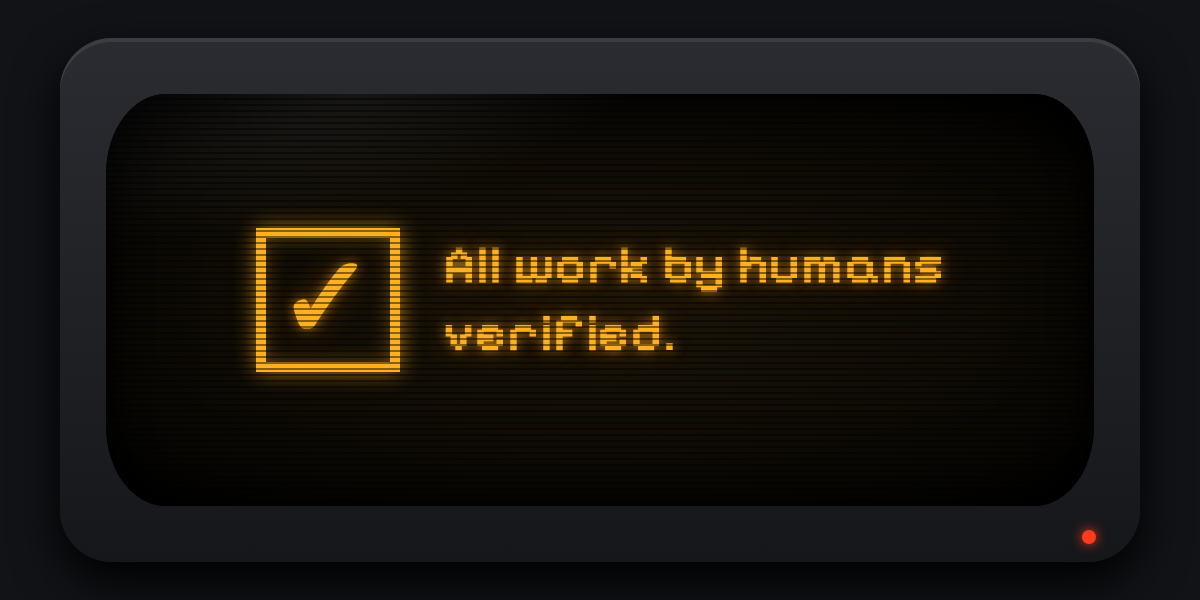
That’s the wrong question. Disclosure only tells players whether AI touched the product, and soon it will touch nearly everything. Tim Sweeney says the tag “makes no sense” for game stores for exactly that reason and wants it gone. [The Verge] He’s right. The warning label is dying, like R-rated movies and “EXPLICIT LYRICS” on music. The fix isn’t less information. It’s a better signal. Steam should let developers check a box that says all work done by humans. Opt in, stand behind it, and get pulled if you lie. |
 |
On YouTube the scarce thing is attention. On a Steam flooded with AI-assisted games, the scarce thing will be proof that people made it, and some players will go looking for exactly that. Give them a filter the algorithm can read. A disclosure is a warning label, and people learn to scroll past warning labels. A human-made box is a feature you can sell. |
|
|
“The algorithm doesn’t read your brand deck. It watches whether players stayed.” |
| — Me |
|
LEVEL 03 · UA EATS BRAND |
The CPG playbook hits a dead end |
This is the part that stings. Performance-marketing UA on the front end, store algorithms on the back end. Between them, they’re going to wipe out a lot of marketing and publishing talent still running consumer-packaged-goods brand playbooks. |
The CPG model goes like this: a big reveal trailer, a media buy, a tagline, a quarterly brand tracker. It assumes you can buy attention and then convert it. In an algorithmic store, attention is earned by behavior: clicks, wishlists, playtime, refunds, reviews. You can’t brand-campaign your way past a recommender that’s watching what players actually do. |
The teams that win run creative testing at volume, measure everything, and treat every trailer, capsule and store page as an experiment. The publishing orgs that survive will look like growth teams with taste. The rest will keep buying billboards for games the algorithm already buried. |
My experienced take: your UA team is part marketing and part sales. They are revenue generators who turn marketing from a cost center into a profit center. The catch? Most companies don’t realize their UA people are some of the most valuable in the company, and in a digital world, they are the backbone of revenue, profit, and growth. |
But few companies are ready to compensate UA people like they are the Atlas holding up the world. |
Don’t think UA is “just another marketing expense.” It is your Sales, Marketing, Outreach, Brand, and drumbeat heard by your Community and your Fans every day. All future winners will invest here. |
LEVEL 04 · THE COUNTER-TREND |
Trust is the new scarcity |
But when everything’s algorithmic, trust gets scarce. And scarce things get valuable again. |
My hot take: respected games journalism is coming back, smaller, sharper and paid for by readers. Former Kotaku writers launched the worker-owned Aftermath in 2023. [The Verge] Former Waypoint staff started Remap, and the Escapist’s video team left to found Second Wind. [The Pitch] In 2025, Fandom sold Giant Bomb to its own staff. [GamesIndustry.biz] Those are human filters people choose to pay for. |
Everything old becomes new again. The trusted critic is coming back, just not from where the last generation came from. The next voices players actually trust will be natives of streaming and social media. They built their own audiences on Twitch, YouTube and TikTok, and the best of them are bringing a new kind of journalistic excellence to the craft: they show their sources, they disclose who’s paying, they play the thing for forty hours on camera, and they say a game is bad when a sponsor would rather they didn’t. |
Plenty of streamers aren’t trying to be journalists, and that’s fine. The ones who are will be the most trusted voices in games, and most of the industry still books them out of the marketing budget like a media buy. |
Publisher brands are turning back into discovery signals too. Strategy players follow Hooded Horse because the label means something about what they’re getting. [PC Gamer] When the store is a firehose, “who put this out?” becomes a shortcut players actually use. |
Long-standing brands like Atari, Sony, and Activision may yet be sitting on the biggest goldmine: the breadth of gamers willing to give their offerings a go. In a future product tsunami of AI-me-too turbulence where (everyone) can self-publish, brand labels powered by algorithmic UA-nets may provide a bastion of high-quality hope that consumers can bet on, and engage in that trusted commerce repeatedly. |
So here’s the whole board. Algorithms win the volume game. AI eats the repetitive work, unless a licensor won’t let it. And the premium goes to anyone players genuinely trust: a label, a critic, a creator, a studio that can honestly check the human box. Be one of those, or rent attention forever. |
The people using frontier AI on real work already feel it. Most of games hasn’t felt it yet. |
|
|
“…[It’s AI] vertigo…” |
| — @giobuilds_ |
|
|
|
|
| WARM |
> SCORCHING < |
INFERNO |
|
| Scorching. The boogeyman is real, and it changes how I’d staff a studio, price a license and underwrite a launch. One flame short of inferno because the counter-trend is real too: trust still wins. |
|
That’s the burn. Think I’m wrong? Good. Hit reply and tell me why. The best pushback may make the next issue. |
Neil Haldar Managing Director, HALDAR & CO · Las Vegas |
|
CONTINUE?
9 · 8 · 7 · ...
The sober one comes out every week. The Burndown tracks what moved in games and entertainment capital markets, and what is still left on the clock.
Read The Burndown
|
|
|
Strategy & capital advisory
for the global gaming industry. Las Vegas. |
|
Opinion, not advice. THE BURN is personal commentary by Neil Haldar. It is not investment, legal, tax or accounting advice, or a recommendation to buy or sell anything. Do your own homework and talk to your own advisors.
© 2026 HALDAR & CO. You get THE BURN because you subscribe to The Burndown.
HALDAR & CO, Las Vegas, NV
Subscribe
|


