|
|
| |
|
|
|
|
|
from the makers of The Burndown |
|
|
By Neil Haldar, Managing Director, HALDAR & CO · 13 min read · Sources at the end |
I spent this week at GamesBeat, and the best part was the conversations. Smart people from every corner of the business, from studios and publishers to the people who fund them. One question kept coming up: what will games financing really look like from here? |
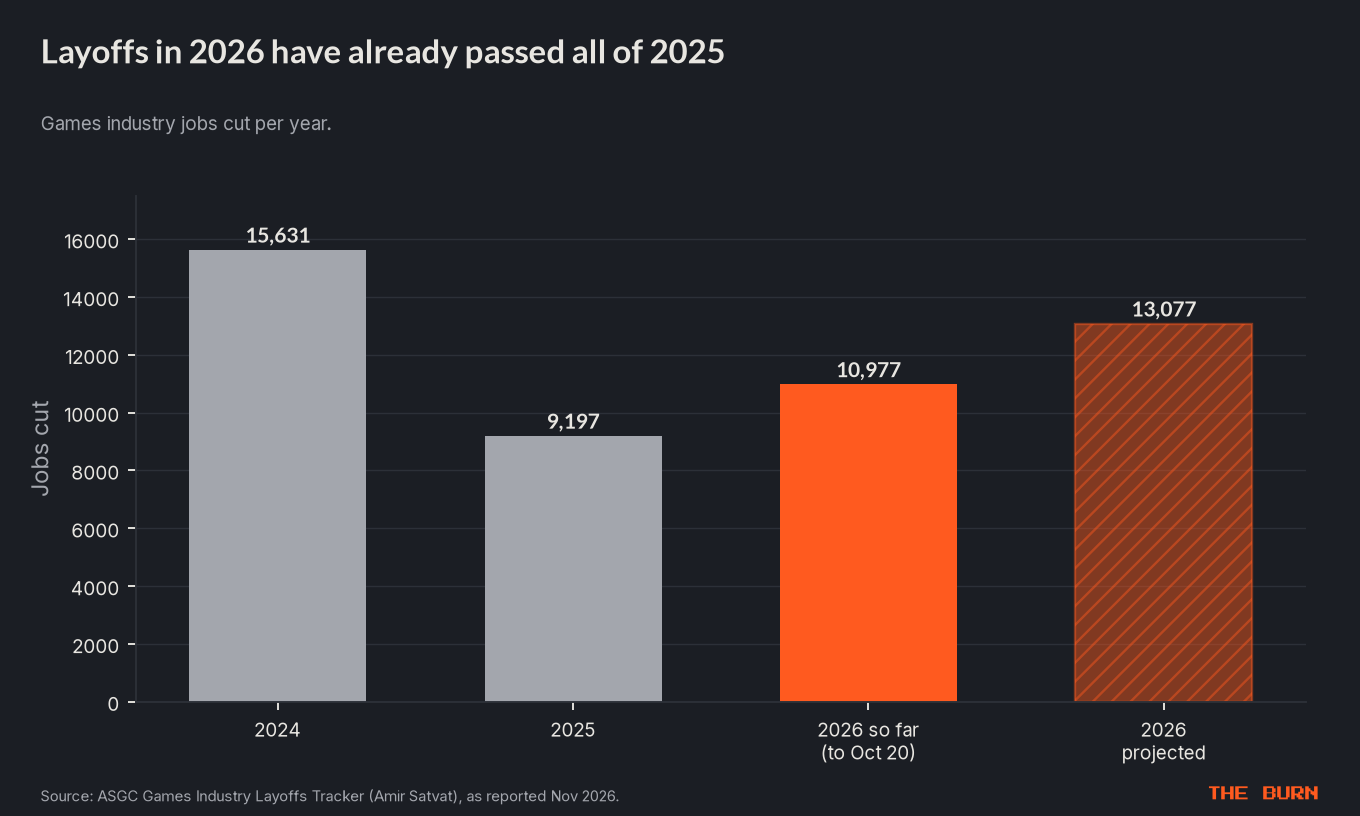
The honest answer is that the old model is being torn apart. Nearly 11,000 jobs have been cut this year by one tracker’s count, already more than all of 2025. Studios are losing a parent’s funding overnight. Nagoshi Studio, founded by the creator of Yakuza, was dissolved on Oct 31 after its owner stopped paying. Venture money is choosier than it has been in years. So the question is less who funds the next big game and more how. |
 |
Here is one possible preview, from a company in the news this week: CI Games of Warsaw. |
It is unusual to have strong public data on a smaller games publisher. Plenty of publishers are private, and many of those that do have to file sit in jurisdictions with much lighter requirements. Poland is different. CI Games is listed on the Warsaw Stock Exchange, where companies must publish material news without delay in numbered current reports, and where quarterly reporting is still required, something many European markets dropped years ago. That means CI’s news and its filings can be matched up and examined in depth. |
With CI’s recent news of EUR €28.6M in bank funding for its new game, Lords of the Fallen II, we can look more deeply at the debt and financing structure, and how CI might ensure its repayment. |
 |
|
CI Games started life as City Interactive in 2002, formed from three small Polish companies, and began as a budget-games publisher. It went public on the Warsaw Stock Exchange in 2007 and dropped the budget model the following year. That bet paid off in 2010 with Sniper: Ghost Warrior, the first of a franchise the company says has sold more than 17.7 million copies across all platforms (FY2025 annual report). The company renamed itself CI Games in 2013. |
The path since then has not been smooth. Sniper Ghost Warrior 3 launched in 2017 and sold over a million copies, but production problems led the company to shrink its core development team to about 30 people in 2018. It rebuilt around a leaner model with outsourced art, started a small-game publishing label called United Label (its first release was Röki), and brought out Sniper Ghost Warrior Contracts in 2019 and Contracts 2 in 2021 on modest budgets. |
At the same time it opened Hexworks, a Barcelona studio built around action role-playing veterans, to rebuild Lords of the Fallen. That reboot arrived in October 2023. The company has said it passed 2.5 million copies across platforms, and it is the best-earning game in the company’s Steam catalog. GameDiscover’s Steam estimate accounts for about 1.37 million of those copies. CI says the game has earned over PLN 300M and broke even in February 2026. Then came the hard part: the cost of a big game. In 2024, CI Games took a significant advance from Epic Games in exchange for exclusive PC distribution of the sequel. Earlier this year it ended that arrangement, and it now plans to publish Lords of the Fallen II itself on every platform, with a physical distribution partner. |
|
GameDiscover’s Steam data lists 16 CI Games titles, with about USD $101.5M in estimated gross revenue and 9.5 million copies sold (third-party estimates, PC only). Steam is only one of CI’s platforms: Valve, which runs Steam, was 37% of CI’s 2025 revenue and Sony 34%, and the console platforms together outearned Steam in every year from 2022 to 2025. |
So I estimated the catalog across all platforms. For each title I scaled the Steam figures up using CI’s own disclosures: its copy counts (over 2.5 million for the 2023 Lords of the Fallen against 1.37 million on Steam, over 3 million for Contracts 2, and over 17.7 million for the Sniper series), and its filings showing a console copy earned about 1.7 times as much as a PC copy (H1 2021). For the 2023 game I used CI’s stated revenue of over PLN 300M directly. Console unit data is not public, so every figure is a range. |
On that basis the catalog has sold about 24 million copies and roughly $360M in gross sales across platforms, about 3.5 times the Steam figure (range $227M to $512M). That multiple sits inside what CI’s revenue mix implies: Valve’s 23% to 39% share of revenue points to 2.6 to 4.3 times. A few games still carry everything. |
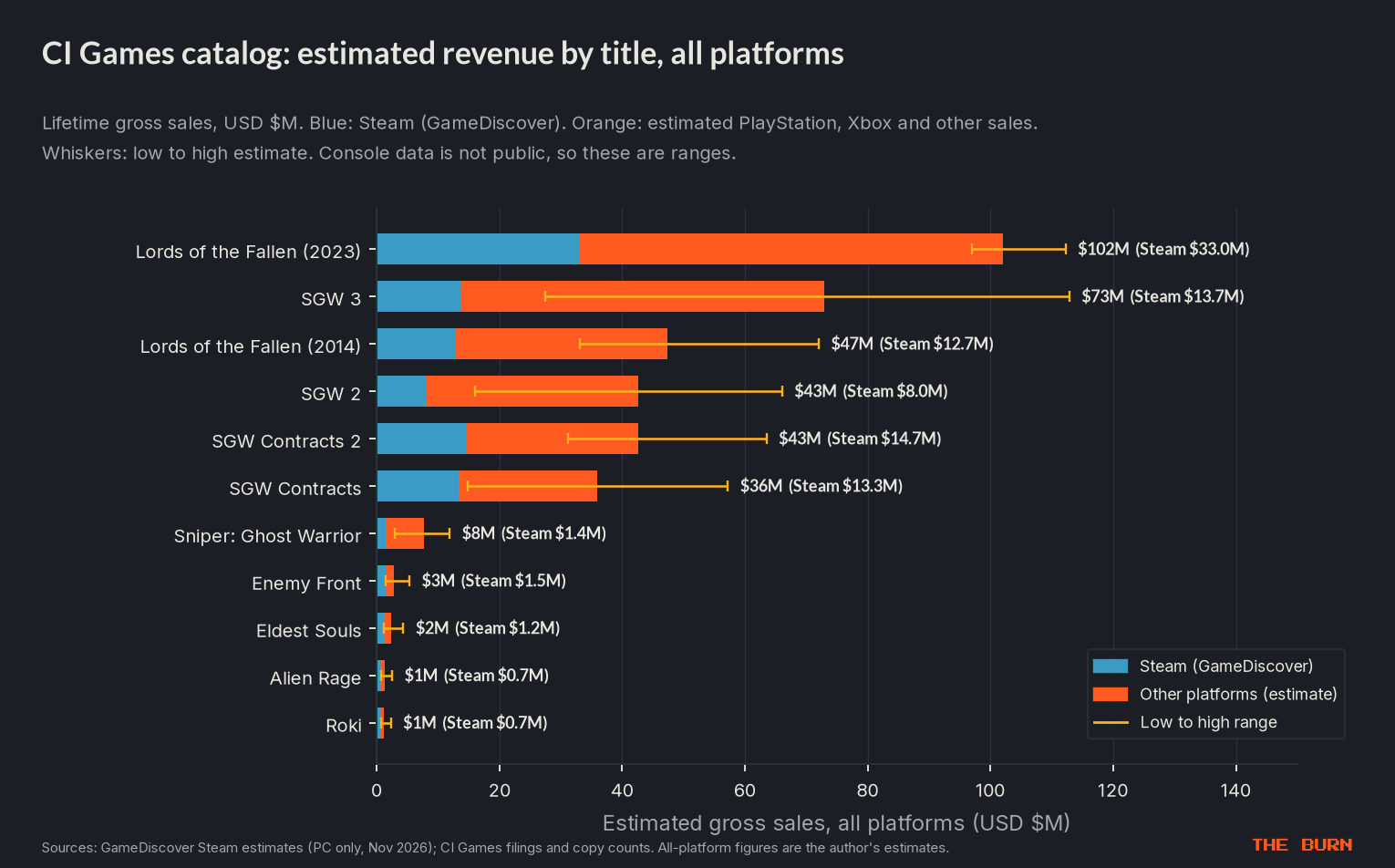 |
The top five titles are 86% of Steam revenue, and about 86% on the all-platform estimate too (83% to 90% across the range). The mix shifts, though: the older console-era Sniper games, SGW 3 and SGW 2, move up, and the first Contracts drops out. Lords of the Fallen (2023) is about $33.0M on Steam, roughly a third of the total, and about $102M across platforms, a little over a quarter. |
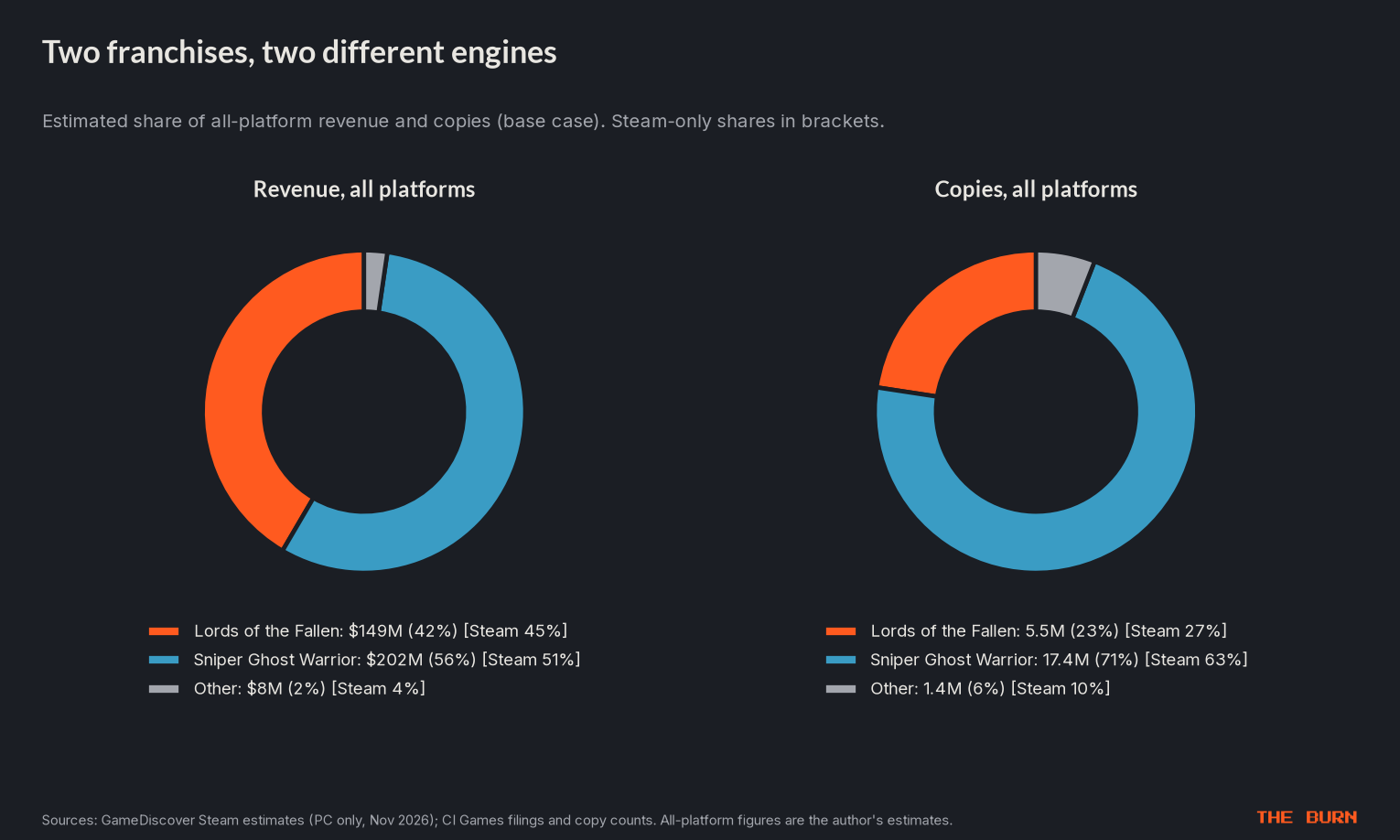
Two franchises do nearly all the work, and they do it differently. |
 |
 |
Sniper Ghost Warrior is the volume engine: CI says over 17.7 million copies, and my estimate is roughly $200M in gross sales across platforms, against 6.1 million copies and $51.3M on Steam. Sniper: Ghost Warrior 2 is the most-sold game on Steam at 1.84M copies, but it earned only $8.0M there. | |
Lords of the Fallen is the price engine: two titles, about $150M across platforms from about 5.5 million copies, against $45.7M and 2.5 million copies on Steam. |
|
The difference shows up in revenue per copy. |
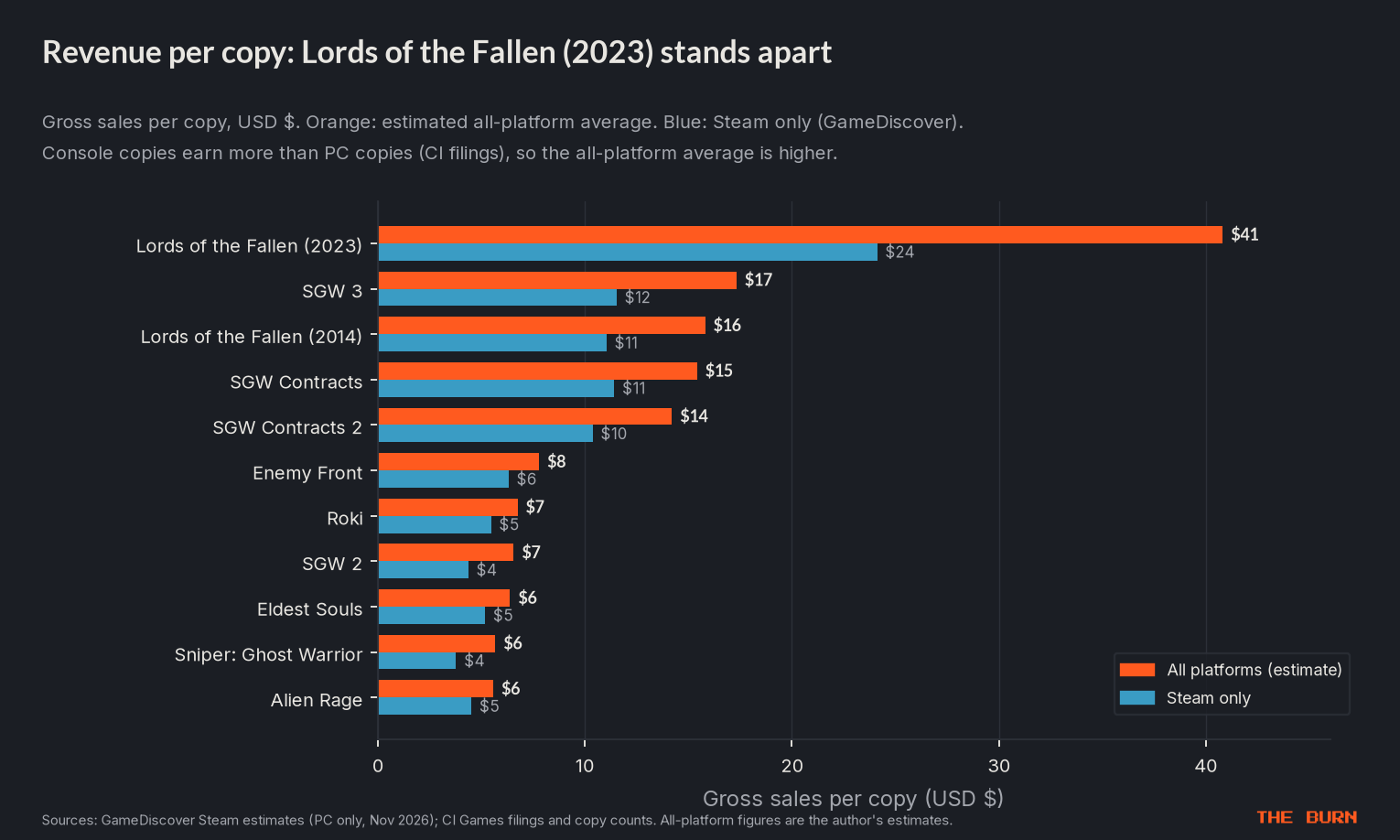 |
Lords of the Fallen (2023) earned about $24 per copy on Steam and about $41 across platforms on my estimate, against roughly $14 to $17 for the next four titles, including the 2014 Lords of the Fallen ($10 to $12 on Steam), and about $6 to $7 for the oldest Sniper games (under $5 on Steam). That lines up with the company’s stated move back to full-price games with Lords of the Fallen. |
The release timeline shows the shape of the business: Sniper releases at roughly $35M to $75M each across platforms ($8M to $15M on Steam), and the 2023 reboot as a clear step up at about $102M. |
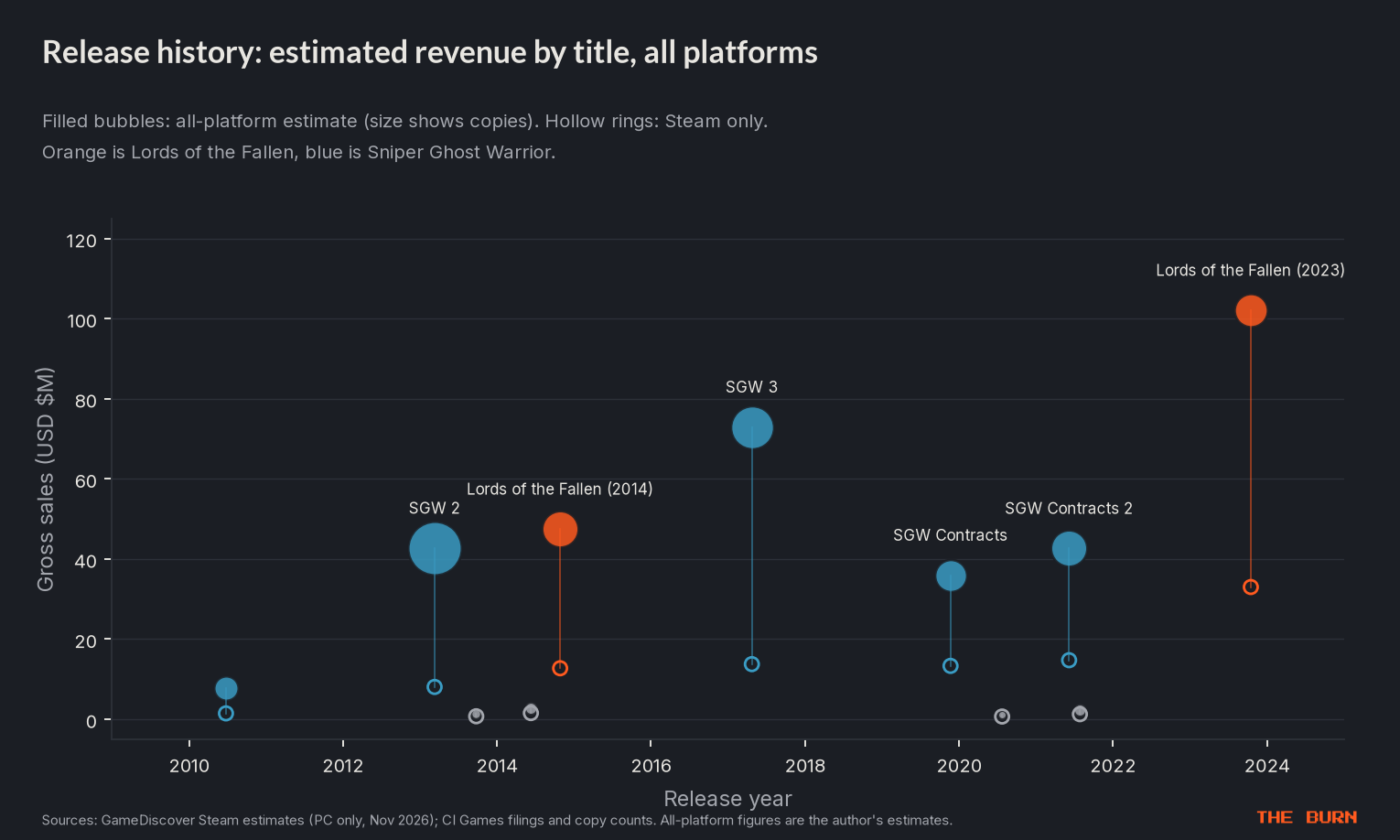 |
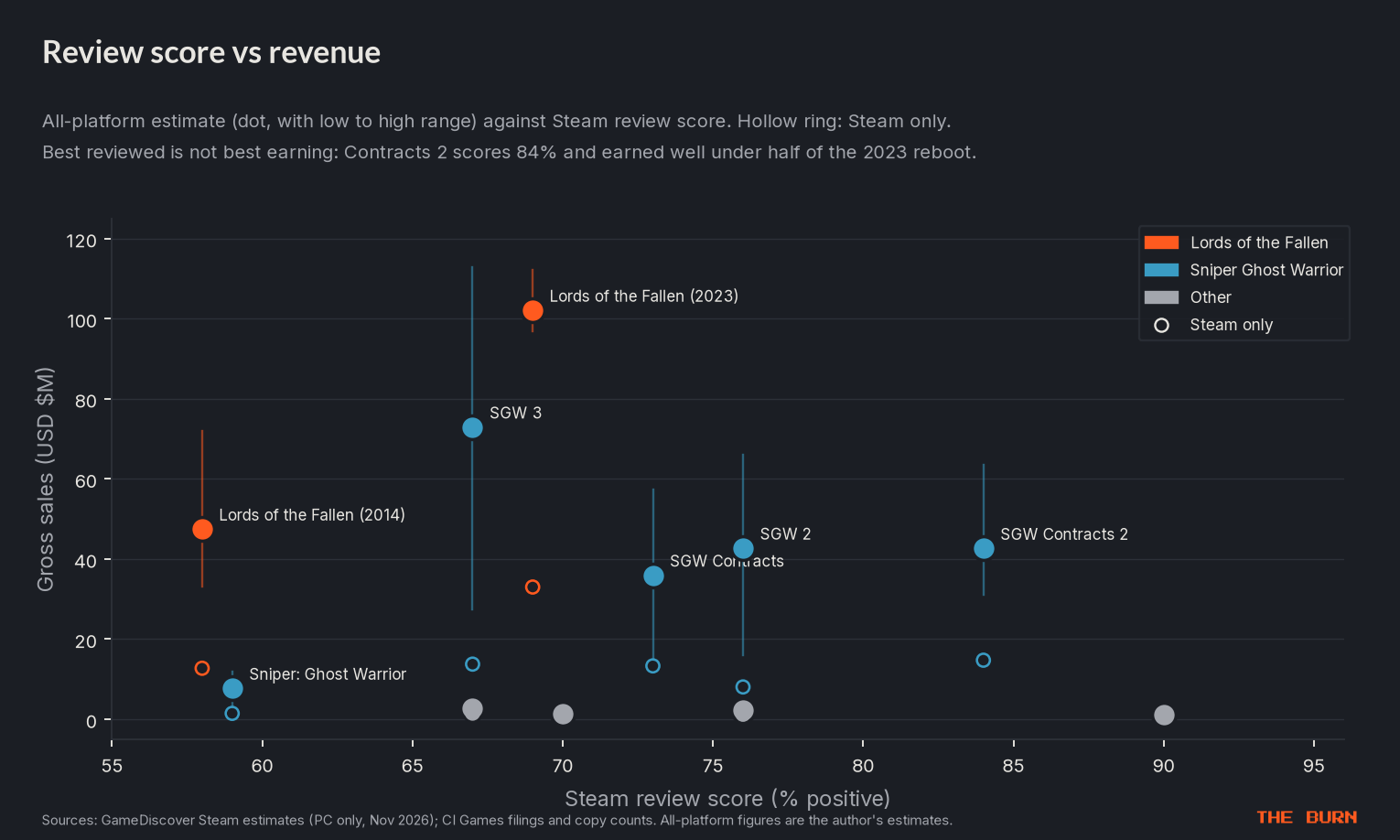
Quality matters, but it does not decide revenue alone. Contracts 2 has the best Steam review score among the big titles (84% positive) and earned about $43M across platforms ($14.7M on Steam). The 2023 reboot sits at 69% and earned more than twice that on either measure. |
 |
 |
|
From HALDAR & CO · Free report
Free government money for your next game, mapped worldwide.
The Global Video Game Incentives Reference covers production tax credits, grants and production support funds, R&D credits and IP regimes, with every scheme tagged by when the money actually arrives: up front, after spend or after income. It is free. You get a personal link by email to the searchable web edition, plus a PDF copy.
130 Pages | 266 Jurisdictions | 641 Schemes | 673 Source links |
Q4 2026 edition by Neil Haldar, Managing Director, HALDAR & CO. Research as of October 30, 2026.
|
|
|
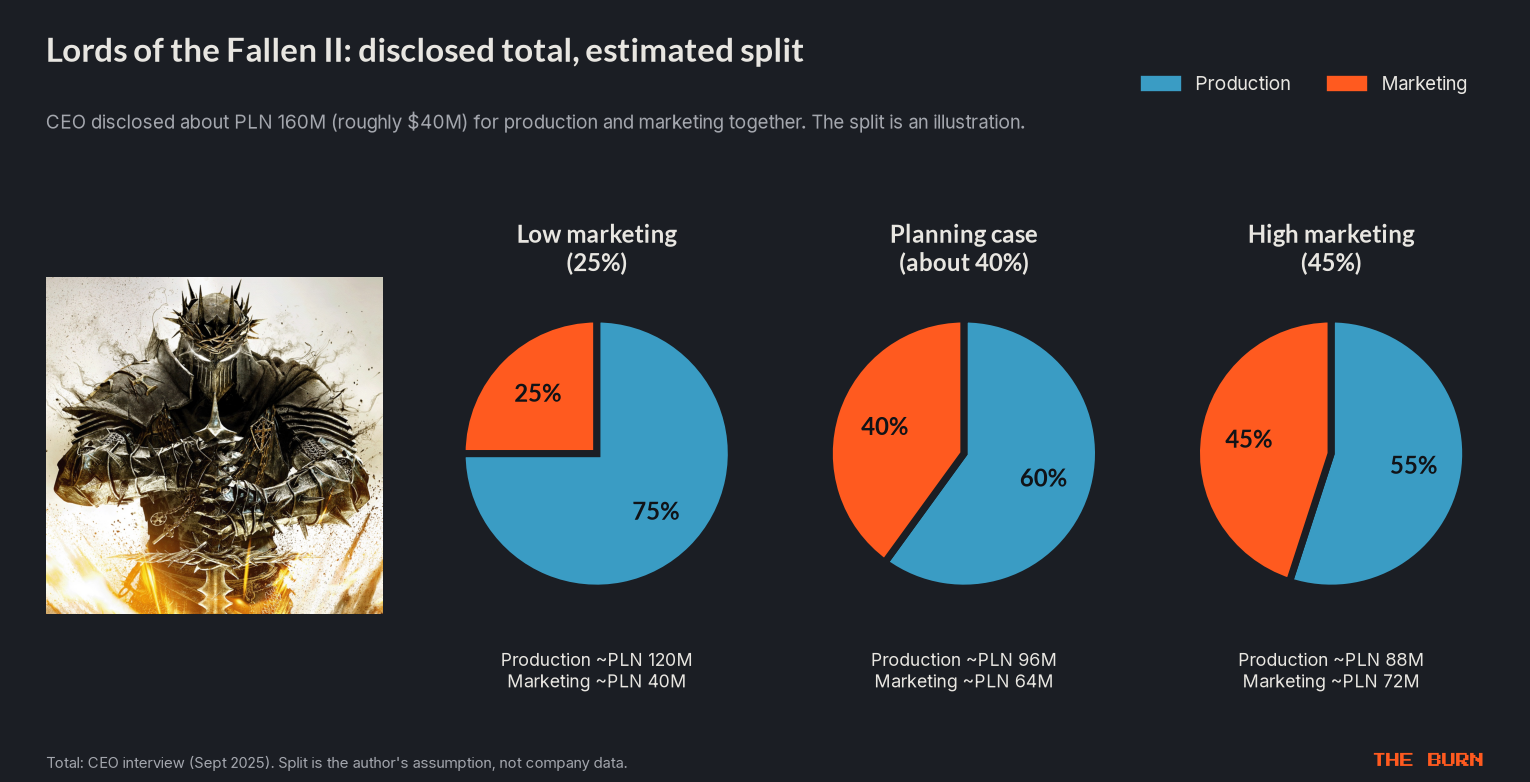
The current game is Lords of the Fallen II, developed by Hexworks, due in Q1 2027. In a September 2025 interview with ISBtech, the CEO estimated production and marketing together at about PLN 160M, roughly USD $40M. For comparison, CI says the 2023 game’s total outlays were PLN 298M, roughly $75M, covering production, marketing, physical media and engine licensing fees ( regulatory filing 15/2026). The split was not disclosed. As an illustration only, marketing in a range of 25% to 45% of the total would be roughly PLN 40M to 72M. |
 |
Pre-release demand is a strong early signal: about 326K Steam wishlists (an estimate) and 21.7K followers, against about 142K followers for the 2023 game. The company has said it will announce a release date in December, when its main campaign begins. |
To pay for it, CI Games has used several tools in turn: |
|
An advance from Epic Games in 2024, for exclusive PC distribution (later ended). | |
About PLN 70M gross from an accelerated sale of new shares in March 2026. | |
On Oct 30, a EUR €28.6M (about USD $32M) syndicated bank loan from Erste Bank Polska and Bank Ochrony Środowiska. |
|
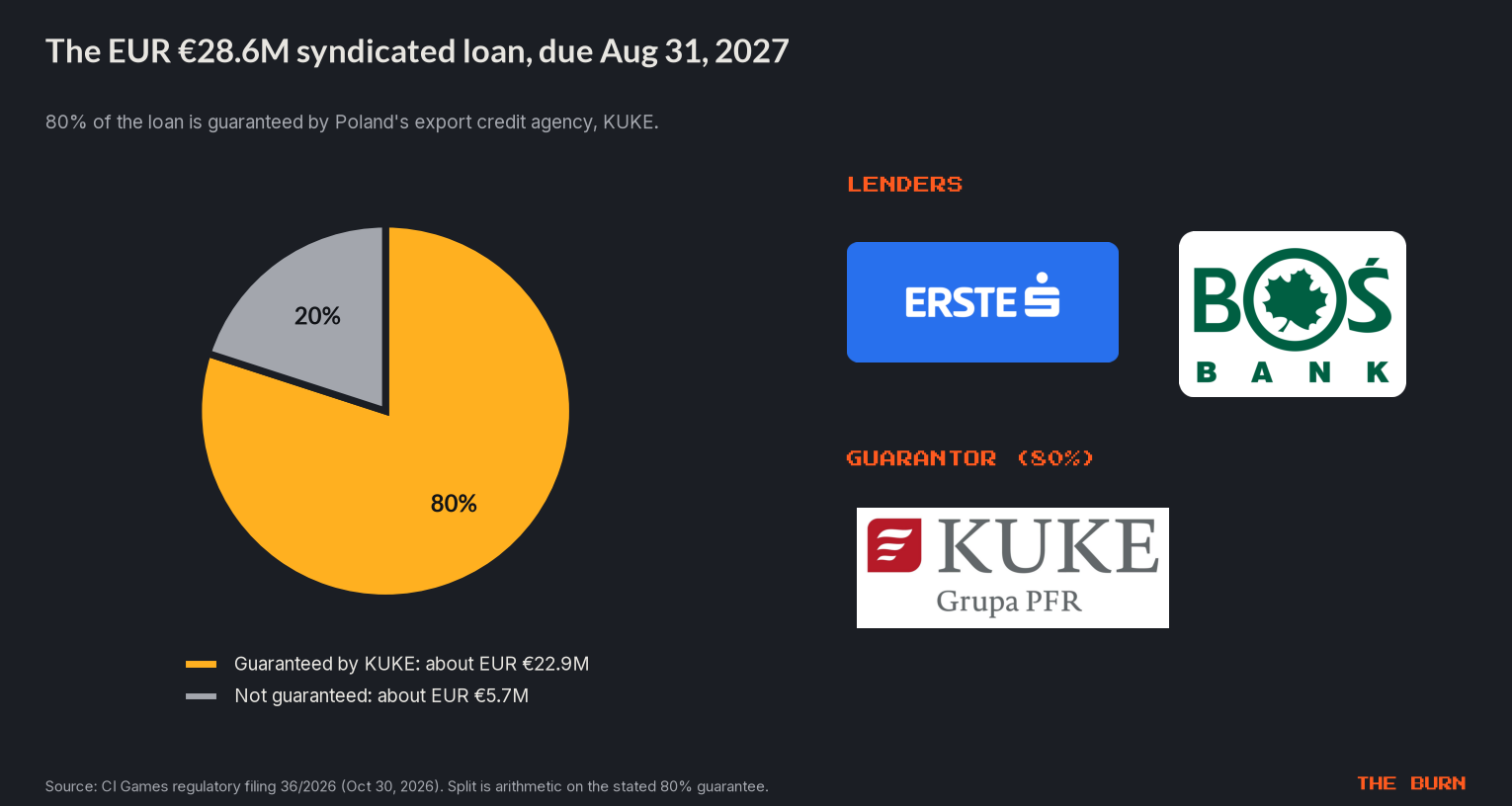 |
The loan is the interesting new piece: |
|
Poland’s export credit agency, KUKE, guarantees 80% of it. KUKE, owned 51.55% by the State Treasury and 48.45% by the state development bank BGK, has guaranteed CI Games before: in December 2025 it covered EUR €2.08M, or 80%, of a EUR €2.6M Santander (now Erste) loan to the company. | |
It is due Aug 31, 2027, and is expected to be repaid mainly from the game’s sales. | |
No new shares are issued for the loan. The CEO and largest shareholder pledged 6.5 million of his shares to back the guarantee and agreed to keep his stake. | |
It refinances existing bank debt as well as funding completion, launch and marketing. The pricing, fees and how much is new money were not disclosed. |
|
A rough way to size the bet, as an illustration: on CI’s filings, the 2023 game brought in about $28 a copy after store fees across all platforms, so covering about $40M takes around 1.4 million copies. At the Steam-only average (about $24 gross, about $17 after a 30% fee) it would take around 2.4 million. |
|
Put together, this is a different shape of financing: a self-published sequel, funded by a sequence of tools, with bank debt (partly guaranteed by the state) secured against a proven franchise and a catalog that already earns. The studio keeps its publishing rights and the game’s revenue. |
It also carries real risk. Debt due in August 2027 sets a clear deadline, and repayment depends mostly on one game’s sales. A sequel that underperforms leaves little room. And the company’s earnings concentrate in one franchise. |
Even so, this may be a model to watch more of. Several things I heard at GamesBeat pointed the same way: funding that looks less like a bet on a pitch and more like lending against what already works. |
|
Suppose Lords of the Fallen II sold nothing and the banks agreed to turn the EUR €28.6M loan into a longer note. Unlike the Steam charts above, this starts from CI’s reported revenue, which already counts every platform: about PLN 63M from the catalog in the first year of a new note on my estimates. Using my assumptions (a 6.5% all in rate, catalog sales falling about 7.5% a year, in line with H1 2026, and a skeleton team costing PLN 10M a year), a 10 year note would cost about PLN 18M a year against about PLN 25M of catalog cash in year one, or 1.4 times cover. That holds for roughly two years and then falls short. A 7 year note starts at 1.1 times and a 5 year note at 0.8 times, short from the first year. Consoles do most of the work. Valve was 37% of CI’s 2025 revenue, so on Steam’s share alone the catalog would not cover its own running costs, falling about PLN 9M short in year one; PlayStation, Xbox and the other platforms supply about PLN 34M of cash in year one, more than the whole PLN 25M available for debt. The fade rate matters as much. At 5% a year, the 10 year note stays covered for about four years; at 15%, one year; at 30%, or if the studio keeps most of its people, coverage breaks at once. My estimate is that the old catalog could carry about two thirds of the loan, not all of it (about 40% to 94% for fades of 10% to 5%). The KUKE guarantee and Tymiński’s share pledge protect the lenders, but neither is income. The loan rests on the sequel. |
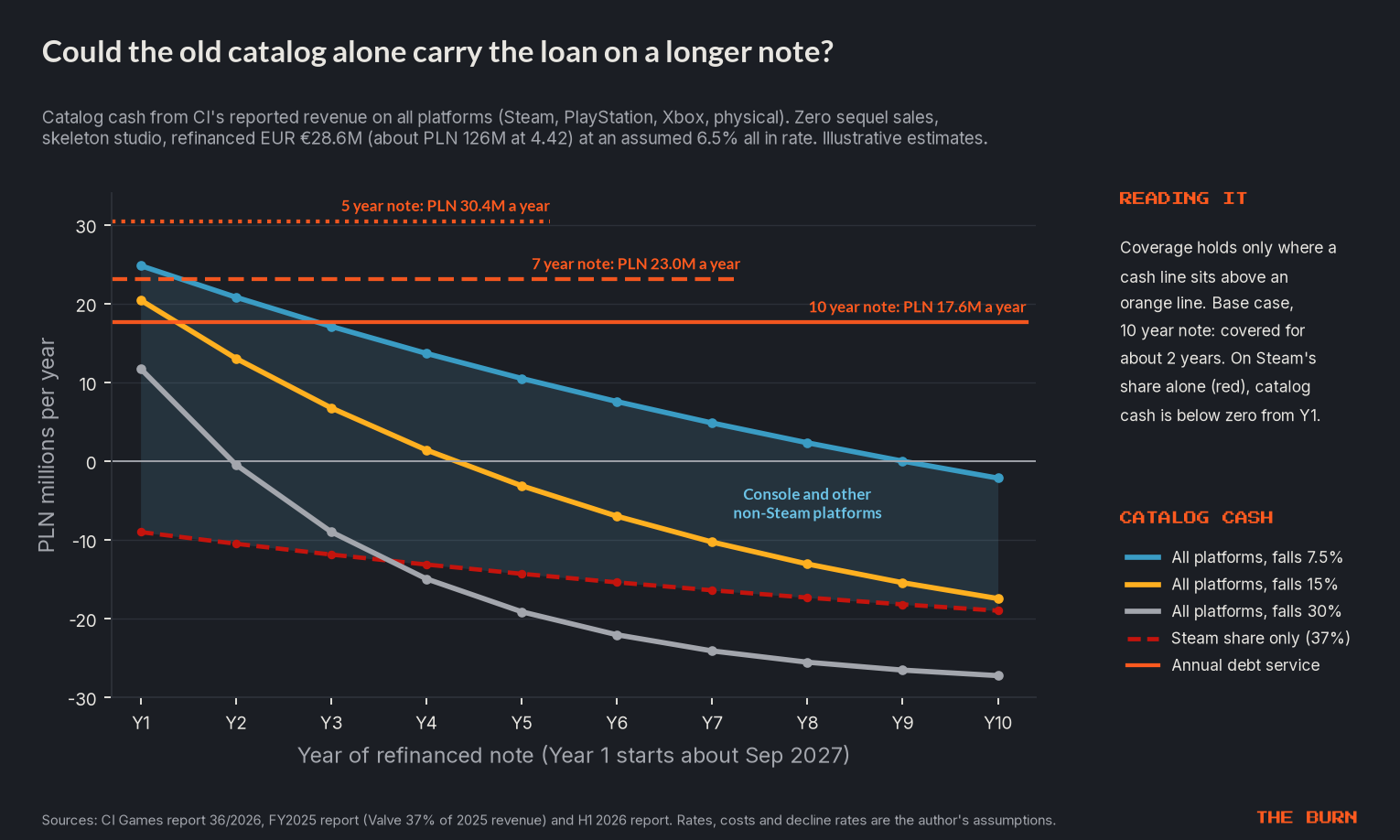 |
Illustrative estimate based on the author’s assumptions (6.5% all in rate, catalog sales falling 7.5% a year, skeleton studio at PLN 10M a year, EUR converted at PLN 4.42). Catalog cash is built from CI’s consolidated revenue, which includes Steam, PlayStation, Xbox and physical sales. The Steam-only line keeps 37% of that revenue (Valve’s 2025 share) with the same costs. Rate and covenants were not disclosed. Not advice. |
Sources: CI Games regulatory filing 36/2026 (Oct 30, 2026); CI Games 2025 annual report (platform shares); CI Games H1 2026 report. |
And if Lords of the Fallen II does sell? I ran 500K, 1M and 1.5M copies over the first 24 months after launch. The per copy figure comes from CI’s filings: the 2023 game earned over PLN 300M on more than 2.5 million copies, blending Steam, PlayStation and Xbox sales. After subscription deals and 15% other sales costs, that is about PLN 96 a copy. Two years of catalog cash plus 500K copies would then cover about 74% of the loan, 1M copies 112% and 1.5M copies 150%. About 850K copies would clear it. GameDiscover’s Steam-only estimate, about USD $24 a copy before store fees (PLN 57 after costs), is the reference: 58%, 81% and 103%, needing about 1.4M copies. But the loan is due Aug 31, 2027, about six months after launch. Repaying it from cash by then would take about 1.45M copies on the filings figure, or 2.4M on Steam’s, so refinancing looks more likely. |
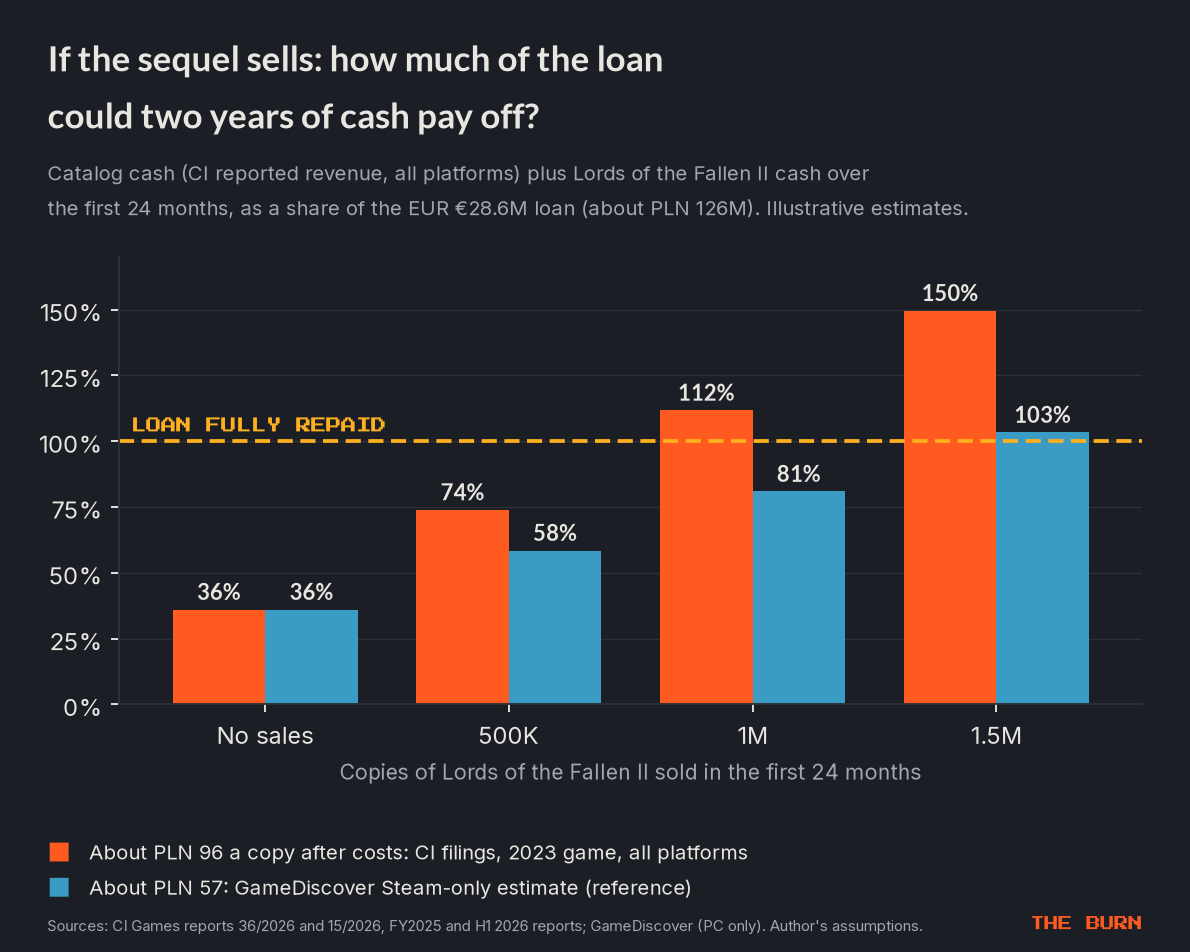 |
Illustrative estimate based on the author’s assumptions. Filings case: about PLN 96 per copy, from CI’s over PLN 300M of revenue on over 2.5M copies of Lords of the Fallen (2023) across all platforms (already net of store shares), less PLN 15M assumed from subscription deals, restated at PLN 4.0 per USD, converted at PLN 3.95 and less 15% other sales costs. Steam-only reference: USD $24.12 per copy (GameDiscover estimate, PC only) less a 30% store share and 15% other sales costs, about PLN 57. 70% of two year sales in the first year; skeleton studio; no remaining marketing deducted, as the budget split was not disclosed. Catalog cash in both cases is the all-platform figure from the chart above and excludes Lords of the Fallen II, so sequel copies are counted once. Maturity test: PLN 60M cash after the drawdown, PLN 50M still to spend and 60% of two year sequel cash collected by Aug 31, 2027. Not advice. |
Sources: CI Games regulatory filings 36/2026 and 15/2026; CI Games press release (Mar 20, 2026); CI Games 2025 annual report and H1 2026 report; GameDiscover Steam estimates (third party, PC only); NBP exchange rates (Nov 3, 2026). |
The CI team, while taking these measures to ensure they own the proceeds of their own efforts, are using their public market listing the way public companies should: issuing new shares, and using debt financing with specific covenants and short-term guarantees, backed by an existing catalog of cashflowing products. This is not a "hail mary" and not an "emergency situation". This is smart financing, and I applaud it. I hope we see a lot more of this in the future. |
I would love to hear what you are seeing. Reply and tell me how your team is financing its next game. |
Managing Director, HALDAR & CO · Las Vegas |
|
This is not investment advice. These materials are provided for informational and educational purposes only and are not an offer to buy or sell, or a solicitation of an offer to buy or sell, any security. They do not take into account anyone’s investment objectives, financial situation or needs. The figures are preliminary estimates based on limited, unaudited and third-party information that I have not independently verified, and they may be incomplete or wrong. Any forward-looking statements, probabilities or valuations are speculative and not guaranteed. Past performance is not indicative of future results, and investments in private securities are illiquid and carry a high degree of risk, including the possible loss of the entire investment. Please consult your own financial, tax and legal advisors before making any decision. |
The sober one comes out every week. The Burndown tracks what moved in games and entertainment capital markets, and what is still left on the clock. |
|
|
|
Revenue strategy
for the global gaming industry. Las Vegas. |
|
Opinion, not advice. THE BURN is personal commentary by Neil Haldar. It is not investment, legal, tax or accounting advice, or a recommendation to buy or sell anything. Do your own homework and talk to your own advisors.
© 2026 HALDAR & CO. You get THE BURN because you subscribe to The Burndown.
HALDAR & CO, Las Vegas, NV
Subscribe · Privacy
|