|
|
 |
|
|
| The Burndown |
| STRATEGY & CAPITAL IN THE GLOBAL GAMING INDUSTRY |
| No. 3 · Week of Oct 19-23, 2026 |
| In game and film production, a burndown is the chart that tracks how much work is left before a project has to ship. Each week, The Burndown looks at what moved in games and entertainment capital markets and what is still left on the clock. |
|
|
|
| In games, owners kept reshaping portfolios: EA made its first big move since its $55 billion take-private by closing BioWare, Microsoft's search for an Arkane Lyon buyer hit a hard deadline, and Supercell and Wildlife Studios bought proven mobile games instead of building new ones. On the funding side, a Wargaming cofounder's vehicle raised $10 million to pay for the soft-launch marketing tests most studios can't finance. In Hollywood, consolidation reached the mid-cap studios: Apollo-owned Legendary made a takeover offer for Lionsgate, and Skydance, carrying the debt from its Warner Bros. Discovery deal, took in a reported $1 billion of new equity from Elon Musk. |
|
|
|
| Ten years of gaming money, in one chart |
| We pulled every disclosed gaming equity round since Q4 2016 into our proprietary precedents database: 4,053 rounds, $45.1B. |
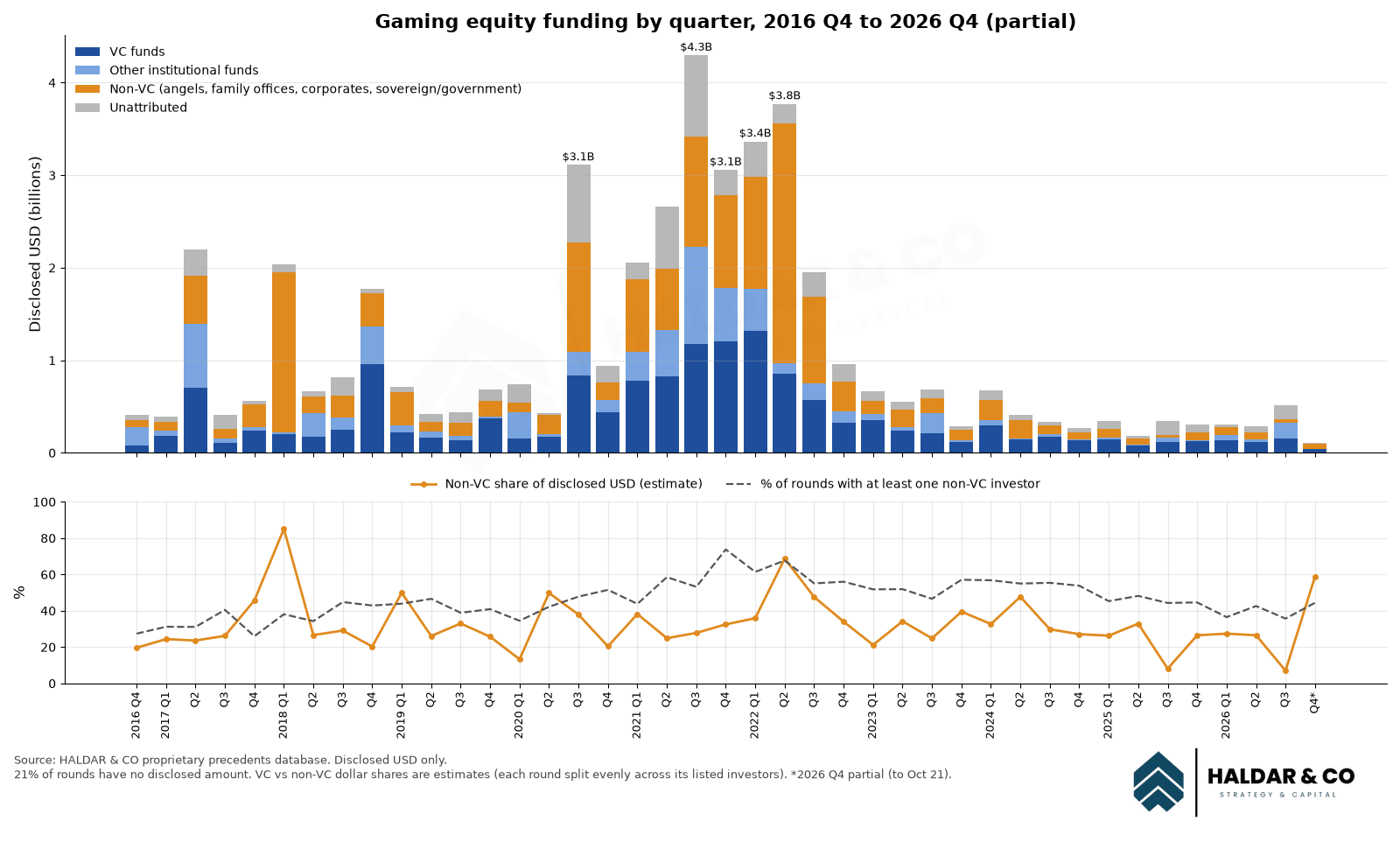 |
| The boom and the hangover are what you'd expect. $12.1B in 2021, about $2.2B in 2023, $1.2B in 2025. One large round has already pushed 2026 past 2025. The typical round is still about $2.5M. |
| The money didn't leave. It changed hands. Take out one outsized AI-tools round and VC still writes about 40% of the dollars, but corporates, family offices, angels and other non-VC investors grew from about 22% to about 32% of the money, even as they show up in fewer deals (39% of rounds this year versus about 60% at the 2021 to 2022 peak). |
| More money is going into fewer, bigger bets. Rounds of $50M or more took over half of 2026 dollars, up from under a fifth last year, while the typical round hasn't moved. The biggest checks went to AI tools and hardware. The game-studio money went to mobile studios with proven live titles. |
| My read, and this is opinion rather than data: the stores are splitting into a K-shaped market, where a handful of breakout titles keep climbing and everyone else fights over what's left. Investors are betting on the top of the K, whether that's proven live games or the tools that make them, and I expect AAA-scale games to be next. That could mean a mushrooming of opportunities in high-end AA and AAA games, because large-scale, top-quality content is the least likely to be disrupted by AI tooling in the near future. |
| For founders, this means fundraising is no longer one pitch to one kind of investor. It's a multi-track process, and it takes real time and expertise to run well. Raising a round in 2026 looks less like a VC pitch tour and more like a capital markets exercise. |
| Disclosed USD only. Investor-type shares are estimates, because each round is split evenly across its listed investors. Source: HALDAR & CO proprietary precedents database. Market commentary, not investment advice. |
|
|
|
|
|
| 01 · POST-BUYOUT RESTRUCTURING |
| EA closes BioWare and cuts about 400 jobs in its first major move since going private |
| On Oct. 21, Electronic Arts told staff it is closing BioWare, the studio behind Mass Effect and Dragon Age, along with its Edmonton office, and cancelling an early-stage Mass Effect project. Bloomberg reported about 400 job cuts, roughly 3% of EA's workforce, including about 50 at BioWare. EA said it will focus on fewer large-scale action-adventure games, keep developing Marvel's Iron Man and the next Star Wars Jedi game, and shrink the team behind skate. Variety reports that Respawn and DICE will work together on Star Wars: Battlefront 3. |
| Why it matters. The PIF, Silver Lake and Affinity Partners consortium took EA private in a $55 billion leveraged buyout, and the new owners are now cutting to fewer, bigger franchises. That makes more closures, IP sales or carve-outs of non-core studios likely. |
| Source: Reuters (via Investing.com) → · Variety → |
|
| 02 · DIVESTITURE |
| Microsoft's sale process for Arkane Lyon faces a Nov. 13 deadline |
| Le Monde reported that Arkane Studios' Lyon team, which Xbox said in July it plans to divest, has until Nov. 13, when consultations with its works council close, as Microsoft looks for a buyer under France's Florange Law. About 217 jobs are at risk, and a union representative said "several forms of takeover" are being considered. Microsoft told Le Monde it is "actively seeking a partner" to finish and commercialize Marvel's Blade, which the union says is near the end of production. |
| Why it matters. This is a rare chance to pick up a well-known team with a nearly finished licensed game. The French legal process puts a public clock on the deal, which favors buyers who can move fast. |
| Source: Gematsu (citing Le Monde) → |
|
| 03 · M&A (CLOSING) |
| Supercell completes its buyout of Metacore and Merge Mansion |
| On Oct. 19, Supercell confirmed it had closed its acquisition of the rest of Metacore, the Finnish developer of Merge Mansion. Supercell was already Metacore's largest shareholder and now owns 100%. Terms weren't disclosed. The deal was announced in May, along with plans for Metacore to cut up to 160 roles in Finland, and was originally expected to close at the end of September. |
| Why it matters. A Tencent-controlled leader is buying out a portfolio company and restructuring it around one proven live game, a common route to liquidity for venture-backed mobile studios whose biggest shareholder is a strategic investor. |
| Source: PocketGamer.biz → |
|
| 04 · M&A (CATALOG ACQUISITION) |
| Wildlife Studios buys PK XD and Afterverse's game portfolio |
| On Oct. 22, Brazil's Wildlife Studios announced it had acquired PK XD and the other games developed and published by Afterverse, a catalog with more than 1 billion downloads. Neither side disclosed the price. Afterverse stays an independent studio, with founders Guilherme Martins and Rodolfo Reis continuing to develop and run PK XD, while Wildlife owns the titles. Wildlife CFO Guilherme Major said the company will keep looking at buying other games and studios it can publish, distribute and operate. |
| Why it matters. This is a structure to watch. The buyer takes the IP and the revenue, and the original team keeps operating the game. That lets mobile sellers get liquidity without a full company sale. |
| Source: Valor Econômico → · The Gaming Era → (both in Portuguese) |
|
| 05 · FUNDRAISING |
| Wargaming cofounder's Mika Games raises $10 million to fund soft-launch studios |
| Cyprus-based Mika Games, founded in 2023 by Wargaming cofounder Nick Katselapov, raised $10 million in a round led by Flint Capital, with new and existing investors participating. It backs free-to-play mobile studios at soft launch, combining equity for development with separate money for paid user-acquisition tests that measure retention, monetization and payback. Its portfolio grew from three studios to five this year, most recently adding Bulberry Studio (Wargard) and LevelApp (Merge Dale, Sea Bloom). |
| Why it matters. Specialist investors are moving into the gap between a soft launch and growth-stage funding, where studios need marketing money, not just development money, to show a game's numbers work. |
| Source: PocketGamer.biz → · GamesBeat → |
|
| 06 · MEDIA CONSOLIDATION |
| Legendary revives its pursuit of Lionsgate and submits a takeover offer |
| On Oct. 20, Bloomberg reported that Legendary Entertainment, owned by Apollo Global Management and company management, had revived talks with Lionsgate Studios and submitted a takeover offer. Terms weren't reported and both companies declined to comment. Lionsgate shares rose more than 15% that day, taking its market value to about $3.6 billion, per Variety. Lionsgate had $1.9 billion of total debt as of June 30, and activist investor Anson Funds has been pushing it to pursue a sale. |
| Why it matters. A deal would give Legendary its own theatrical distribution and a 20,000-title library. It would also be the first big test of whether the stand-alone studios left after the Skydance-WBD merger get bought by private equity-backed producers or by European consolidators like Banijay and Mediawan. |
| Source: Variety → · Bloomberg Law → · The Hollywood Reporter → |
|
| 07 · CAPITAL RAISE / MEDIA |
| Elon Musk reportedly invests about $1 billion of equity in Skydance |
| Semafor reported on Oct. 22 that Musk invested about $1 billion in Skydance, the company formed when Paramount closed its acquisition of Warner Bros. Discovery on Oct. 6. Board member Laurene Powell Jobs also contributed equity around the same time. Skydance came out of the merger with about $80 billion of net debt and has committed to $6 billion of cost cuts over three years. A day earlier, John Malone predicted Musk could put in about $10 billion and that a global output deal with SpaceX would follow. Neither has been confirmed. |
| Why it matters. Skydance is raising equity from wealthy individuals after largely tapping out debt markets, so further private placements, asset sales and content licensing deals are all on the table as it tries to cut its debt. |
| Source: Semafor → · Deadline → |
|
|
| Deal flow to watch |
| ▪ | Small purchases by services groups. Pole To Win's Side bought the art production business of Chengdu-based Roboto Entertainment for up to $65,000 ($25,000 at signing plus a $40,000 earn-out), taking on no liabilities. Side calls it its biggest art expansion since 2021. Outsourcing groups are using small asset purchases like this to add capacity in China. Pole To Win filing (TDnet) | PocketGamer.biz |
| ▪ | Lionsgate's next catalyst. Lionsgate reports results for the quarter ended Sept. 30 after the market closes on Nov. 5, its first report since the Legendary offer surfaced. Banijay, Mediawan and France's Bolloré Group have also shown interest in the past without making formal offers. Variety | TheWrap |
| ▪ | Netflix leans on licensing. Netflix's Q3 revenue rose 12% to $12.87 billion, but it cut its 2026 ad-revenue outlook to about $2.7 billion from roughly $3 billion, and the shares fell about 6% after hours. The shareholder letter promises more licensing and third-party content, like its TF1 partnership in France, which means more buyers for library and output deals. CNBC | Netflix shareholder letter (SEC) |
| |
|
|
Important disclosure. This newsletter is provided for informational and educational purposes only. It does not constitute investment, legal, tax or accounting advice, a recommendation, or an offer to sell or a solicitation of an offer to buy any security or to participate in any transaction, and it should not be relied upon in making any investment decision. Nothing herein is tailored to the circumstances of any reader; consult your own professional advisors. Information is drawn from third-party public sources, including those compiled in the HALDAR & CO proprietary precedents database, believed to be reliable but has not been independently verified, and no representation is made as to its accuracy or completeness. Figures are as reported by the cited sources; undisclosed terms are not estimated. Opinions and forward-looking views are those of the author as of the date of publication, are not guarantees, and may change without notice. Past performance is not indicative of future results. HALDAR & CO provides strategic advisory services and may have, or may seek, business relationships with companies or parties mentioned. Third-party links are provided for convenience; HALDAR & CO is not responsible for their content.
© 2026 HALDAR & CO. All rights reserved.
You are receiving The Burndown because you asked for HALDAR & CO market updates.
HALDAR & CO, Las Vegas, NV
Subscribe · Privacy · or reply to neil@haldar.co.
|
|